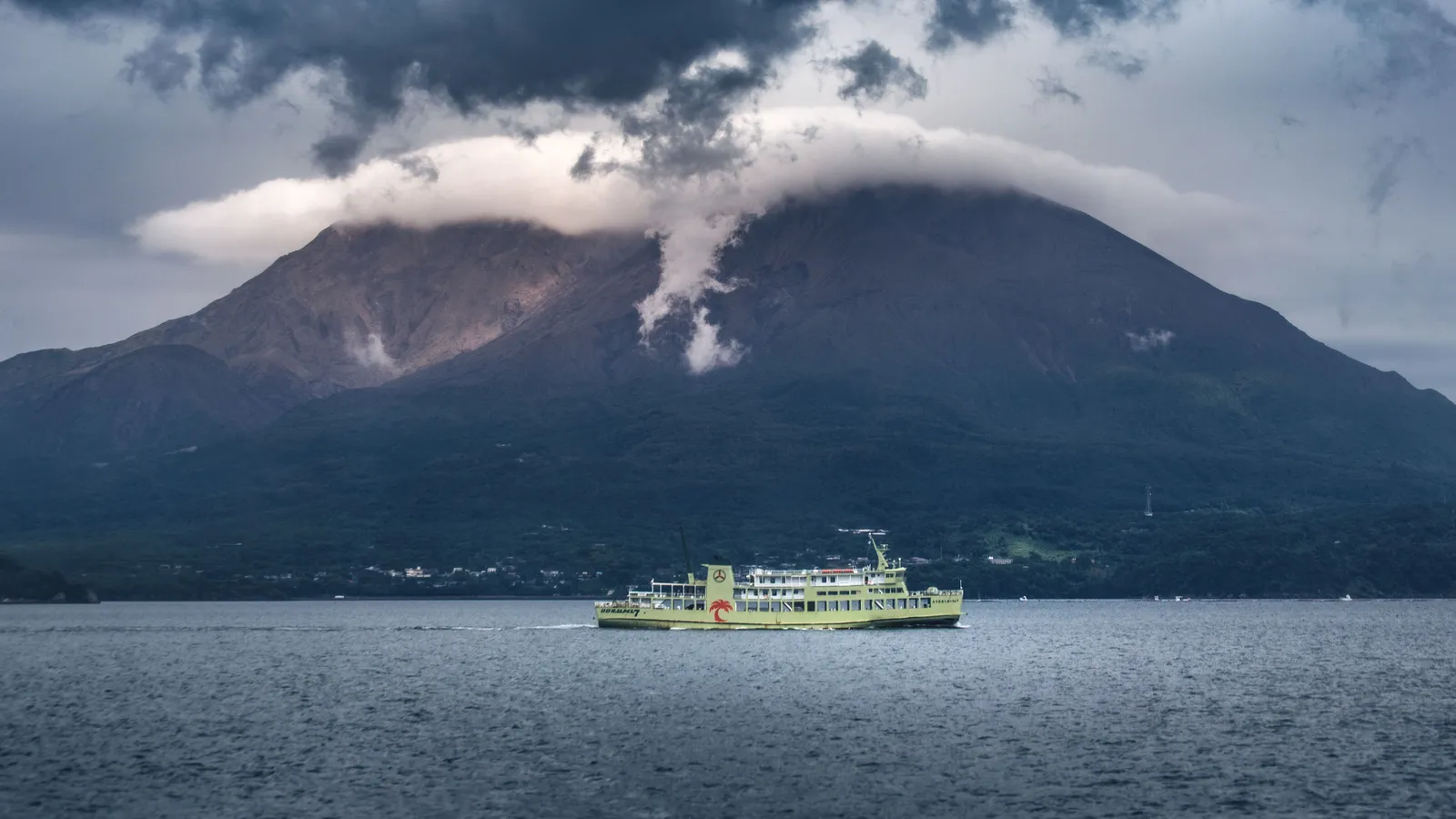
The ferry from Kagoshima to Sakurajima costs ¥250 and takes fifteen minutes. Nobody checks a ticket when you board on the city side. You walk up the gangway, find a seat facing the volcano, and pay at the far end, where a gate and a card reader are waiting.
That is the cheap part settled. The real money gets spent after you step off, because Sakurajima is a 36-kilometre loop of lava fields and switchback roads, and the port sits in one corner of it. A loop bus covers the west side for ¥500 a day; an e-bike costs ¥5,500 for three hours. A taxi tour runs to five figures, and a custom day with a private car and guide starts at ¥110,000.
Most people need the bus, a pair of legs and one decision about the east side. Here is what each way of getting round costs, what it can reach, and where the volcano gives you things for free. Prices are the ones in force in November 2026, adult fares, tax included, from the operators’ and the city’s own pages.
In This Article
The ferry: ¥250, paid on the island, and no longer all night
The Sakurajima Ferry’s fare table is short. An adult pays ¥250 each way, a child from age one to the end of elementary school pays ¥130, and one preschool child per paying adult rides free. The fare went up from ¥200 in July 2024, and the city has announced plans for a much bigger rise, to ¥400 for adults paying cash or card, from July 2027. Commuter passes and coupon books are due to stay at their current prices.
Every fare is collected at Sakurajima Port, in both directions. Arriving, you pay at the gate as you leave the ship; going back, you pay at the same gate before you board. The gate takes cash, credit cards (JCB, Visa, Mastercard, Amex, Diners, Discover, UnionPay) and nationwide IC cards such as Suica, ICOCA, SUGOCA and nimoca. It cannot top a card up, so arrive with enough balance, and tell the staff if you are paying by card.
The bigger change is the clock. Older guides still describe a ferry that never stops, and for years that was true. Since 1 October 2025 the city has suspended the sailings between midnight and 04:00, so the first and last sailings now look like this:
| From | First sailing | Last sailing |
|---|---|---|
| Sakurajima Port | 04:00 | 23:00 |
| Kagoshima Port | 04:30 | 23:30 |
In between, the weekday timetable runs a boat every 20 minutes from Kagoshima between 07:00 and 18:40, then every half hour to 20:30, then 21:30, 22:30 and 23:30. Weekends and holidays get more boats: 104 sailings a day against 94 on weekdays. The crossing takes about 15 minutes, nearer 20 in rough weather, and at Sakurajima Port boarding closes 30 seconds before departure, so do not cut it fine.
The Kagoshima terminal is a five-minute walk from the Suizokukan-guchi tram stop, or one minute from the Kagoshima Suizokukan-mae (Sakurajima Sanbashi) bus stop. A bicycle costs ¥160 extra each way, a 50cc scooter ¥330. A car between four and five metres long costs ¥2,350 each way, a kei car ¥1,700, both including the driver’s fare.
Convenience stores sell a discounted ferry ticket for ¥240. It saves ¥10, expires after a month and is not refunded if the ferry is cancelled for weather. Skip it.
The loop bus covers the west side only
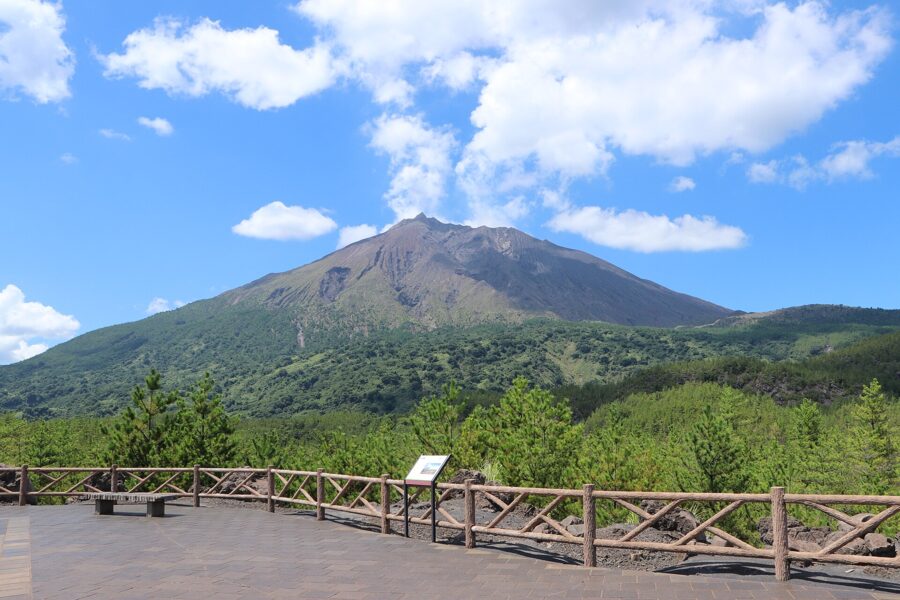
The Sakurajima Island View is a city-run loop bus from Sakurajima Port up to Yunohira Observatory and back. The Island View timetable and fares, revised in October 2026, have it leaving the port every 30 minutes from 09:30 to 16:30, fifteen runs a day, with a full loop taking 55 minutes. Yunohira, at 373 metres the highest point the public can reach on the volcano, is 40 minutes from the port.
A single ride costs ¥230 (child ¥120). The Island View one-day pass costs ¥500 (child ¥250) and is sold on the bus itself, so anyone getting off more than once should buy it at the first stop. Two routes alternate: the buses leaving the port on the half hour detour to the International Volcanic Sabo Center, the ones on the hour skip it. The bus takes cash, credit cards and the local Rapica card, but not Suica or the other nationwide IC cards, which catches out people who paid for the ferry with one.
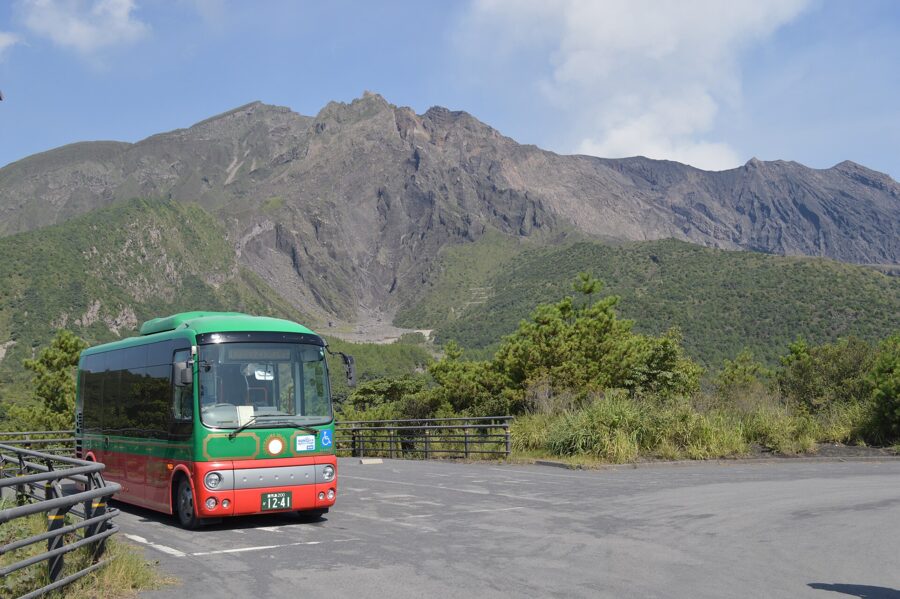
Here is the gap. The Island View never reaches the south or east coast, so Arimura Lava Observatory and the buried torii at Kurokami are off its map. For Arimura, the bureau’s own leaflet tells you to change at Satsuma Akamizu to the Kagoshima Kotsu route bus towards Tarumizu, a private line that takes neither the CUTE pass below nor Suica. Kurokami is reached by city bus routes 60 and 70 round the north coast, some runs needing a change at Higashi-Shirahama, with few departures, so check the timetable before you commit an afternoon to it.
The Island View’s last run leaves the port at 16:30 and is back at 17:25. Plan the day backwards from that.
CUTE: when ¥1,400 beats single fares
The CUTE pass covers the city trams, the city buses (including the Kagoshima City View sightseeing loop and the Island View) and the Sakurajima Ferry, as often as you like. The one-day pass costs ¥1,400 (child ¥700) and the two-day pass ¥2,100 (child ¥1,050), with adult meaning junior high school age and up. It is a calendar-day ticket, not 24 hours: the two-day version runs out at the end of the day after you start. Private buses and private ferries are excluded.
Buy it as a scratch card at the tourist information desks at Kagoshima-Chuo Station or Tenmonkan, at either ferry ticket office, or as a digital ticket in the myroute or Wakuwaku apps. Every CUTE comes with a discount passport for more than ten sights, Sengan-en included.
Whether it pays depends on how much you do in the city. The single fares are ¥200 for the tram (up from ¥170 since 1 August 2026), ¥230 for any city bus or City View ride, ¥250 for the ferry and ¥500 for the Island View day pass. An island-only day from Tenmonkan works out like this:
- Tram to Suizokukan-guchi and back: ¥400
- Ferry there and back: ¥500
- Island View day pass: ¥500
- Total: ¥1,400, exactly the price of the CUTE
So for the volcano alone, the pass is a wash. Add Sengan-en by City View on the same day, two more rides at ¥230, and singles come to ¥1,860; the CUTE saves ¥460 and throws in the discount passport. If you are staying in the city and skipping the island, the tram, bus and City View one-day pass costs ¥700 and is the better buy; its old ferry discount ended on 30 June 2024.
Older guides also mention a Welcome CUTE sold to overseas passport holders. It appears nowhere on the city’s or the tourism association’s current ticket pages, so do not plan around it; the ordinary CUTE is the pass on sale.
Bike, cross bike or e-bike on Sakurajima
The coast road round Sakurajima is about 36 kilometres. The Visitor Center’s cycling notes put the loop at three to four hours for an ordinary rider and warn that about three quarters of the island’s roads are hill roads. Fallen ash makes the bends slippery, and the Visitor Center does not rent bikes out in rain, strong wind or ashfall.
Three counters near the port rent bikes, and they rent different things:
| Where | Bike | Price | Catch |
|---|---|---|---|
| Sakurajima Rentacar, 1 minute from the terminal | Ordinary bike | ¥400 an hour | Cash only; not for the Yunohira climb |
| Sakurajima Visitor Center, 10 minutes’ walk | 24-speed cross bike | ¥3,300 for 3 hours, then ¥550 an hour | Age 18 and up, ID shown in person, out by 14:00, no bookings |
| Rainbow Sakurajima, 8 minutes’ walk | E-bike | ¥5,500 for 3 hours, then ¥1,000 an hour | Seven bikes; paid up front, no refund for an early return |
Sakurajima Rentacar’s price list is the cheapest way onto two wheels by a distance: two hours for ¥800. It opens 08:00–18:00 (17:00 in winter). The island’s tourism portal asks people not to ride ordinary bikes up steep roads such as the one to Yunohira. The shop also has electric-assist bikes that its own page does not price, so ask when you arrive.
The Visitor Center’s ten cross bikes come with a helmet; optional insurance covering a collection if you puncture mid-island is ¥550 more. The desk takes rentals 09:00–14:00 and wants the bike back by 17:00. The island’s cycling site lists the e-bikes at Rainbow Sakurajima for riders roughly 155–180 cm tall and notes that some days they are not running, so ring the hotel before you set out.
The e-bike earns its ¥5,500 in two places: the climb to Yunohira, and the full loop with the east side included, where the bus cannot take you. For the flat coast between the port, the foot bath and Karasujima Observatory, a ¥400 bike does the same job. A realistic full loop with stops takes four hours, which is ¥6,500 on an e-bike and ¥3,850 on a cross bike.
Back in the city, the e-bike is the share bike. Kagorin, Kagoshima’s bike share, runs electric-assist bikes at ¥165 per 30 minutes through its app. A day pass costs ¥1,650 from a convenience store (you need a phone that can receive texts) or ¥2,200 at a hotel or staffed counter, and the bike goes back by 23:59 the same day. For a city day of Sengan-en, Shiroyama and Tenmonkan, that is the cheapest way to cover ground at your own pace.
Rental car, taxi or a private driver
With three or four people, a car starts to beat the bikes. Sakurajima Rentacar, by the terminal, charges ¥5,000 for two hours in a kei car and ¥6,500 in a standard car, fuel and insurance included, with ¥1,000 or ¥1,500 for each extra hour. Driving the loop takes about two hours with stops. You need a licence; an overseas one means an International Driving Permit and your passport.
Renting a car on the island also saves the car ferry fare, which is ¥2,350 each way for a standard car from the city side. Four people in a kei car for two hours pay ¥1,250 each, plus their own ferry fares.
Taxi companies sell fixed sightseeing courses. Kagoshima Kotsu Taxi’s model courses list a three-hour Sakurajima loop from the city, taking in Yunohira, Arimura and the Kurokami torii, at ¥12,000 for a small taxi, ¥15,000 for a medium one and ¥18,000 for a nine-seater, booked online. Tsurumaru Kotsu’s four-hour Sakurajima course from Kagoshima-Chuo Station is ¥28,000 for four passengers or ¥42,000 for nine. Neither price includes the ferry, and neither page is dated, so confirm the figure when you book.
Run the numbers for four people on the Kagoshima Kotsu course: ¥12,000 for the car, ¥4,700 for the car on the ferry both ways, ¥2,000 for four passengers both ways. That is ¥18,700, or about ¥4,700 each, for three hours with a driver who knows where the ash is. On the island itself, Sakurajima Kanko Taxi sends cars to the port, but publishes no tour prices.
At the top of the range sits the TABIKAGO+ custom tour with a private car and driver, listed on the city’s tourism site from ¥110,000. It runs 08:00–18:00 with pickup at Marine Port Kagoshima, city hotels or Kagoshima-Chuo Station, a driver and guide, and support in English, Chinese and Spanish. It makes sense for a cruise group with one day and no Japanese, or a large party splitting the cost. For two people, the taxi course does the island for about a sixth of the price.
The free sights, and a ¥460 soak
The best things on Sakurajima have no gate. The foot bath in Yogan Nagisa Park is about 100 metres of hot-spring water from 1,000 metres underground, open 09:00 until sunset and free; it is closed all day on 1 and 2 December 2026. Bring a towel, or buy one at the Visitor Center next door.
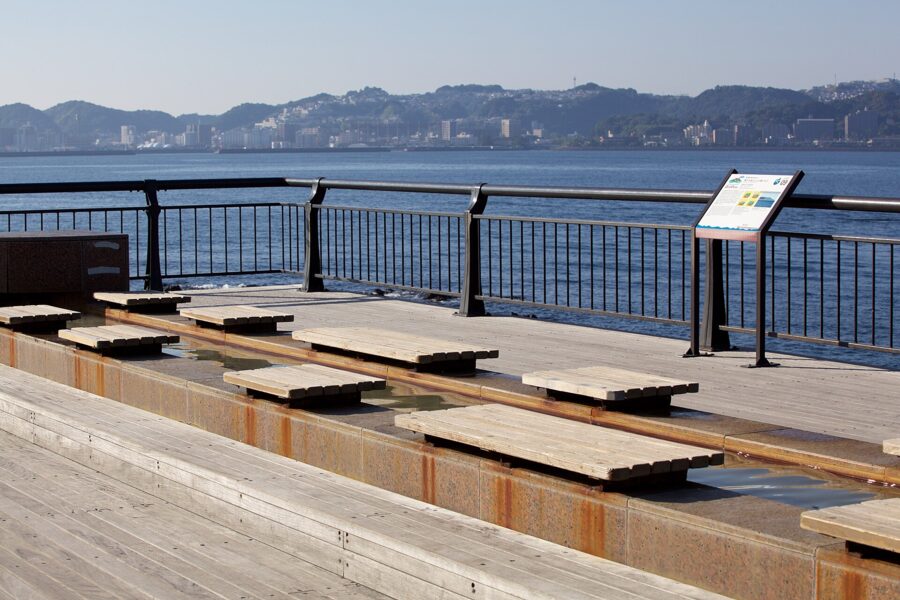
The Sakurajima Visitor Center is free, open 09:00–17:00 every day, and worth fifteen minutes before you pick a route. From the park, the Nagisa lava trail runs about 3 kilometres along the shore to Karasujima Observatory, flat and easy on foot.
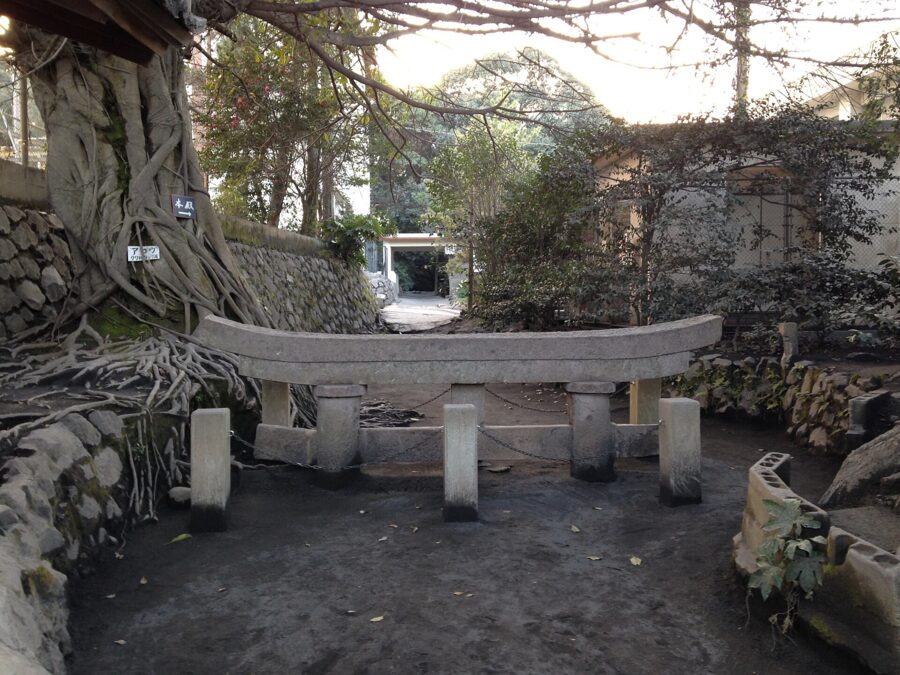
Up the hill, Yunohira Observatory costs nothing to stand on; only its shop keeps hours, 09:00–17:00. Arimura’s lava path is free too, and so is the buried torii at Kurokami: a shrine gate three metres tall, swallowed to its crossbeam by the ash of the 1914 eruption, about 30 minutes from the port by car.
On the city side, the Shiroyama lookout, 107 metres up and a City View stop, gives the classic view of the volcano across the bay for nothing. Tenmonkan’s covered arcades are free to wander and sit on the tram line back from the ferry.
Sengan-en is the one paid sight worth the money. Sengan-en’s admission is ¥1,600 for adults (¥800 for school students), covering the garden, the Goten residence and the Shoko Shuseikan museum, open 09:00–17:00 with last entry at 16:30. The annual pass costs ¥2,400, so anyone going twice in a year should buy that at the first visit. Use the CUTE’s discount passport at the ticket window; it cannot be combined with other discounts.
For a bath, Magma Onsen at Rainbow Sakurajima charges ¥460 for adults, 11:00–21:00 with last entry at 20:00, shampoo and soap supplied, towels ¥200 or ¥300 to rent. It shuts to day bathers on 1 and 2 December 2026. In the city, the prefecture’s public bath price cap rose on 1 November 2026 from ¥460 to ¥500 for anyone 12 or older, ¥150 for ages six to eleven. That ¥500 is the most a neighbourhood sento can charge.
A costed day, and what each option really buys
A day that sees most of the island for little money, on a weekday:
- 09:00 ferry from Kagoshima, paid with a CUTE bought at the terminal.
- 09:30 Island View from Sakurajima Port, off at Yunohira at 10:10.
- 10:40 Island View back down, to the port at 10:55, then a ten-minute walk to the Visitor Center and the foot bath.
- Lunch, then the Nagisa trail to Karasujima Observatory and back.
- Magma Onsen, then a ferry back to the city.
- City View to Sengan-en by 14:30, to give it two hours before the 17:00 close.
That costs ¥1,400 for the CUTE, ¥1,600 for Sengan-en before any passport discount and ¥460 for the bath: ¥3,460 per person. Swap the bus for a four-hour e-bike loop that takes in Arimura and Kurokami and the island alone costs ¥7,000 (¥6,500 for the bike, ¥500 for the ferry), before the bath.
| Option | Price | Catch |
|---|---|---|
| Ferry plus Island View day pass | ¥1,000 | West side only; last bus 16:30 |
| CUTE one-day pass | ¥1,400 | Pays only if you add city rides |
| Ordinary bike, Sakurajima Rentacar | ¥400 an hour | Cash only; flat coast only |
| Cross bike, Visitor Center | ¥3,300 for 3 hours | Out by 14:00; no rain or ash |
| E-bike, Rainbow Sakurajima | ¥5,500 for 3 hours | Seven bikes; ring first |
| Kei car, Sakurajima Rentacar | ¥5,000 for 2 hours | Licence and IDP needed |
| Taxi course, 3 hours | ¥12,000 per car | Plus about ¥4,700 car ferry |
| TABIKAGO+ private car and driver | From ¥110,000 | Full day; worth it only for a group |
Fifteen minutes and ¥250 gets you to the volcano. A ¥500 bus gets you up it, and the foot bath at the bottom costs nothing at all.