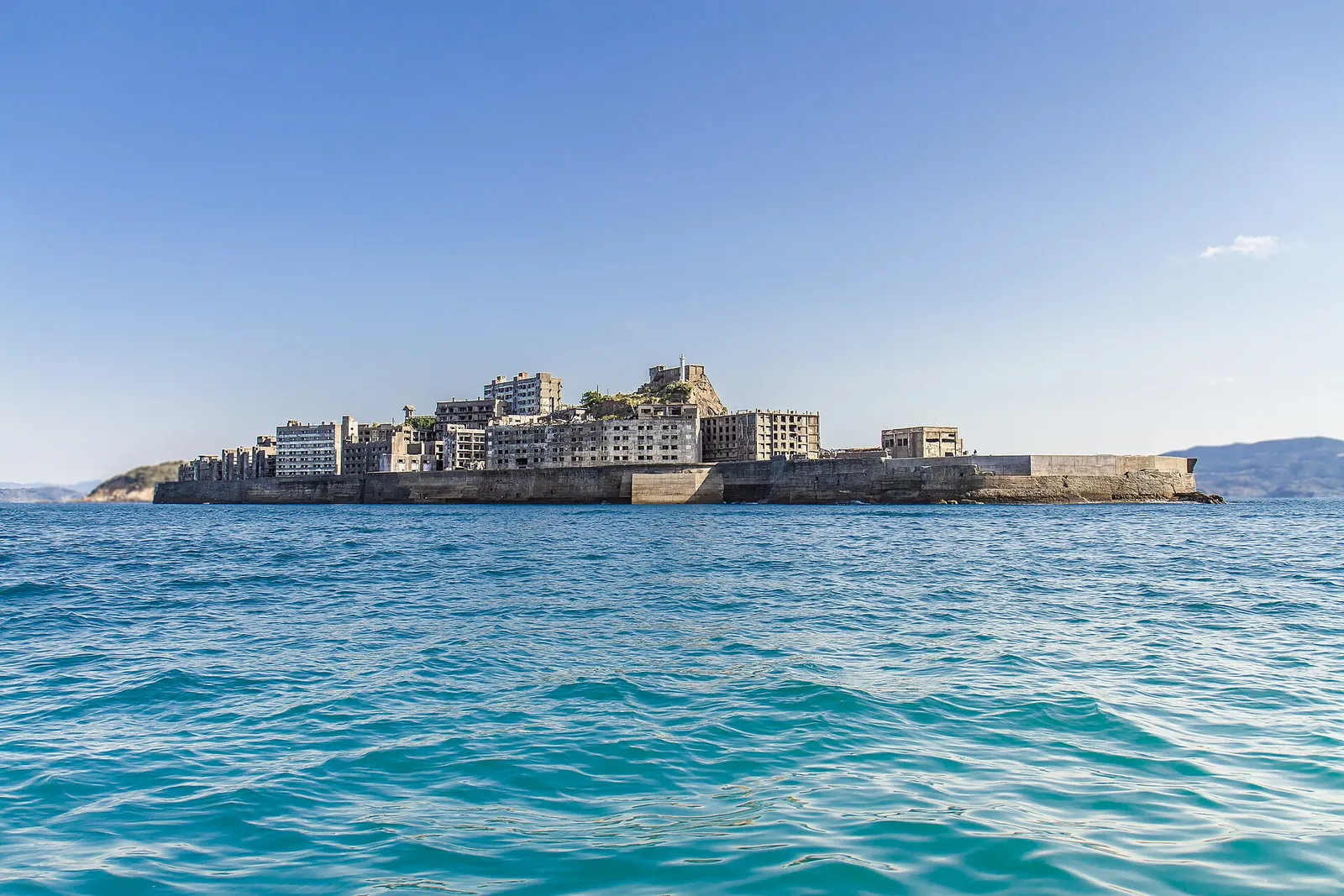
Every landing tour to Hashima ends up on the same 220 metres of fenced concrete walkway, stopping at the same three viewing areas, for the 40 to 50 minutes that a Nagasaki City rule allows. Four companies run daily landing cruises from the city harbour. The cheapest adult ticket comes to ¥4,250 all in. The dearest comes to ¥12,650.
The gap is not the island. It is a better seat, a museum ticket, an English-speaking guide, and above all what each company does with your money when the wave gauge off Iojima reads more than half a metre and the boat circles Gunkanjima instead of tying up at it.
That happens often enough that the refund rules matter more than the brochure photos. One company keeps your whole fare when the boat turns for home; another hands back ¥1,650 and has already shown you its museum. Fares here are the ones in force in November 2026, per adult, tax included.
In This Article
- Four boats, one walkway: the landing cruises compared
- Gunkanjima Cruise: the cheapest, with a free museum on the way
- Yamasa Kaiun runs the big boats and the English days
- Seaman Shokai, with the heritage campaigners as guides
- Gunkanjima Concierge costs most and refunds most
- The landing fee, and the days you will not land
- Add-ons that work when the sea says no
- Nagasaki the cheap way, around the boat
- What a guide and a car cost for a full day
Four boats, one walkway: the landing cruises compared
Every price below is the boat fare plus the ¥650 city landing fee, which each operator collects from you on top of its own fare. The times are the regular daily sailings.
| Operator | Adult total | Sails from, length | Catch |
|---|---|---|---|
| Gunkanjima Cruise (Takashima Kaijo Kotsu) | ¥4,250 booked online; ¥4,650 otherwise | Motofune pier, 09:10 and 14:00, about 3 hours with a Takashima stop | No fare refund if you cannot land; cash only; no English guiding advertised |
| Yamasa Kaiun | ¥5,350; from ¥4,450 with its early-booking fares | Nagasaki Port Terminal, 09:00 and 13:00, 2.5 hours | Only 10% of the fare back if you cannot land |
| Seaman Shokai | ¥4,550 with its ¥300 discount ticket; ¥4,850 without | Tokiwa No. 2 pier, 10:30 and 13:40, about 2.5 hours | No fare refund if you cannot land; cash only, no cards |
| Gunkanjima Concierge, Standard | ¥6,150 weekdays; ¥6,650 weekends and holidays | Tokiwa pier, 10:30 and 13:40, about 2.5 hours plus the museum | Dearest, but includes the ¥1,800 Digital Museum and refunds the most |
Gunkanjima Cruise: the cheapest, with a free museum on the way
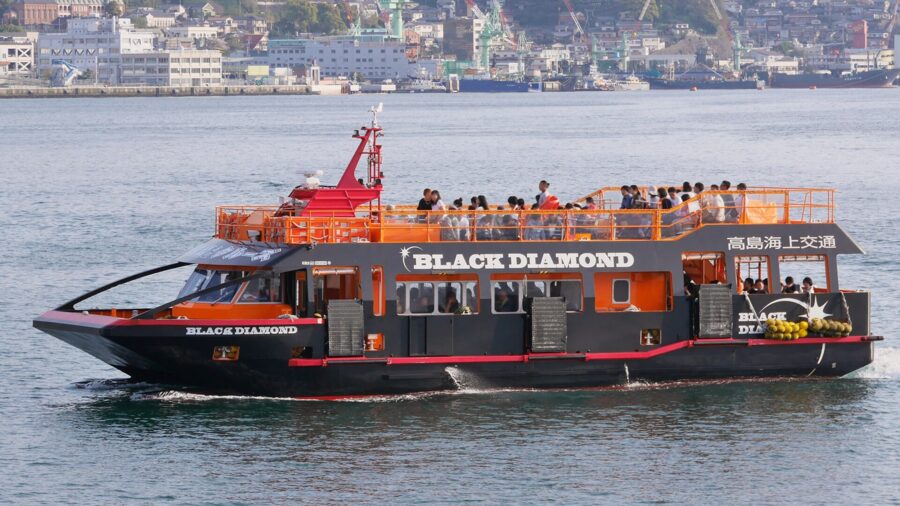
Gunkanjima Cruise’s fares are ¥3,600 for adults and for junior and senior high school students when you book on its website, and ¥1,800 for children from age four. Book any other way and it is ¥4,000. You pay cash on the day at the company office at 11-22 Motofunamachi, a short walk from the Ohato tram stop, and you need to check in at least 20 minutes before sailing.
The trip is the longest of the four and the only one with a second island. The boat runs about 40 minutes to Takashima, where you get 30 minutes at the free coal museum with its scale model of Hashima, then ten minutes on to Hashima for roughly 20 minutes of circling and about 45 minutes ashore. The morning boat is back at 12:10, the afternoon one at 17:10. The company advertises no English guiding, though the safety pledge everyone signs comes in an English version.
The catch is in the small print. If the sea stops the landing, or the city closes the island, the trip becomes a circling cruise and the fare is not refunded; only the landing fee comes back. You can cancel free of charge once the tour has been switched to a cruise, as long as you do it before departure.
The online price holds until March 2027. From 1 April 2027 the web fare becomes ¥3,800 on ordinary weekdays and ¥4,000 on what the company calls specified days: weekends, holidays, the New Year and Golden Week periods, late March, all of August, October and November, and the last week of December.
Yamasa Kaiun runs the big boats and the English days
Yamasa ran the first landing cruise when the island reopened to visitors in April 2009 and still runs the largest boats on the route, two craft carrying more than 220 passengers each. Yamasa’s Japanese booking page lists ¥4,700 for adults and for junior and senior high school students, and ¥2,350 for primary pupils, the fares in force since a revision on 1 October 2025. Its tiered early-booking fares bring the adult price down as far as ¥3,800, and the fare for a junior or senior high school student travelling with family is 10% off.
Boats leave from the floating pier at Nagasaki Port Terminal at 09:00 and 13:00 and are back at 11:30 and 15:30; check in at window 7 on the ground floor of the terminal, which opens 45 to 60 minutes before departure. Yamasa’s English page says it arranges free English-speaking guides on Tuesdays, Thursdays, Saturdays and Sundays, and Chinese on the other days. That page still shows an older fare, so go by the Japanese one.
If the boat cannot land, the trip becomes a 110-minute circling cruise and you get back the landing fee plus 10% of the fare. Cancellation is free up to 15 days before; after that it costs 10% to 30% of the fare, half from 15:00 the day before, and all of it once the boat has left. In March 2026 the company published the improvement measures it was required to take under a government transport-safety order, which you can read from its homepage.
Seaman Shokai, with the heritage campaigners as guides
Seaman Shokai’s fare table lists ¥3,900 for adults, ¥3,500 for junior and senior high school students and ¥2,000 for primary pupils. Those are the prices with the company’s ¥300 discount ticket, which you do not need to print; the full adult fare is ¥4,200. Payment is cash only, no credit cards, and preschool children are not taken.
The boat, Saruku II, takes a maximum of 96 passengers and leaves from Tokiwa No. 2 pier beside Nagasaki Mizubenomori Park at 10:30 and 13:40, back around 13:00 and 16:10. The guide is Sakamoto Dotoku, who chairs the citizens’ group that campaigned for the World Heritage listing, or one of its members. The company lists no English guiding.
If the boat cannot land, Seaman turns the trip into a circuit of Hashima plus a landing on Takashima, with the same return time, and refunds only the landing fee. Its FAQ says cancellation charges start at noon the day before, and on the day you pay the whole fare.
Gunkanjima Concierge costs most and refunds most
Concierge’s Standard plan is ¥5,500 on weekdays and ¥6,000 on weekends, holidays and school holidays, with junior and senior high school students ¥1,000 less and primary pupils ¥3,000 or ¥3,500. Standard means unreserved seats on the lower deck, numbered in booking order. Premium buys a reserved central seat upstairs for ¥9,000 or ¥10,000, and Super Premium a reserved window seat for ¥11,000 or ¥12,000.
Every plan includes the Gunkanjima Digital Museum, where you check in with a QR code before walking to Tokiwa pier. Boats sail at 10:30 and 13:40, you are ashore from 11:35 to 12:20 or 14:40 to 15:25, and you are back around 13:05 or 16:10. You can go back into the museum free after the trip, up to its last entry at 16:30. Children under three cannot board.
Concierge is the only one of the four that turns a failed landing into a real discount. Its refund table re-prices you at the cruise-only fare, so a weekday Standard adult who paid ¥6,150 gets ¥1,650 back. If the boat does not sail, you get everything back and half-price museum entry. Cancellation is free until eight days before, 30% from seven to two days before, and the full fare the day before.
A fifth boat, the small fishing boat Dai-nana Ebisumaru (第七ゑびす丸), is listed on Nagasaki Prefecture’s tourism site and runs from Nomozaki at the tip of the peninsula, far closer to Hashima than the city harbour. It publishes no current fare online, so it is not in the table; call before planning around it.
The landing fee, and the days you will not land
Nagasaki City’s landing fee is ¥650 for adults and ¥320 for primary, junior and senior high school pupils, on top of the boat fare; preschool children pay nothing. It went up on 1 April 2026: the new schedule more than doubled the old ¥310 and ¥150. Every operator hands it back when you do not get off the boat.
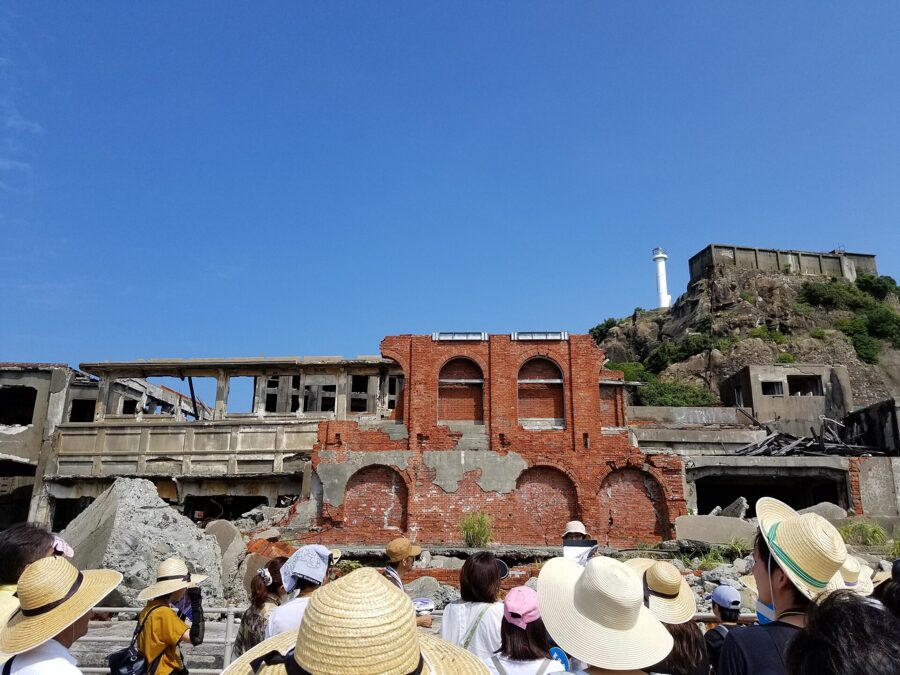
The rules for tying up are the same for every company. Nobody lands when the wave gauge off Iojima, about 10 kilometres from Hashima, reads more than 0.5 metres, when the wind at the island tops 5 metres a second, or when visibility drops below 500 metres. The gauge sits halfway out, so a glassy morning in the harbour proves nothing.
Yamasa works on about 100 days a year meeting those standards. Nagasaki City’s tourism site puts the landing rate at around 60 per cent, with little difference between companies, though how often each one sails at all depends on the size of its boat. The city also shuts the walkway when it needs to: after a notice on 21 October 2026 that the railings were coming down ahead of a typhoon, landings did not resume until the afternoon of 28 October.
Here is what that means for an adult whose boat sails but cannot land:
- Gunkanjima Cruise: ¥650 back; you keep the Takashima stop.
- Seaman Shokai: ¥650 back; you get a Takashima landing instead.
- Yamasa Kaiun: ¥650 plus ¥470, so ¥1,120 back on a full-fare ticket.
- Gunkanjima Concierge: ¥1,650 back on a weekday Standard ticket, and you have still had the museum.
Even after its refund, a Concierge ticket that does not land costs ¥4,500, still more than a Gunkanjima Cruise ticket that does. If the boat does not sail at all, you get your money back with every company.
Book online as early as your plans allow, take the earliest day of your Nagasaki stay, and keep a second day free: Concierge does not run a waiting list, and a cancelled tour on your last morning has no fix. Wear flat shoes, since the pier decking is steel grating, and take seasickness tablets before you board rather than after.
Add-ons that work when the sea says no
The Gunkanjima Digital Museum’s admission is ¥1,800 for adults, ¥1,300 for junior and senior high school students and ¥800 for primary pupils. It sits a short walk from Tokiwa pier near Oura Cathedral, opens 09:00–17:00 with last entry at 16:30, and takes an hour to an hour and a half. It closes for maintenance from 19 to 21 January 2027.
The sums are simple. Yamasa at full fare plus the museum is ¥7,150, against ¥6,150 for Concierge on a weekday with the museum included. If you want both, Concierge is the cheaper way to get them; if you do not care about the museum, it is the dearest boat on the water.
Two museums cost far less. The Takashima Coal Museum is free, open 09:00–17:00 and two minutes from Takashima port, which is about 35 minutes by boat from Nagasaki; Gunkanjima Cruise passengers see it as part of the trip. The city’s own Gunkanjima Museum in Nomozaki charges ¥420 and opens 09:00–17:00, but it is a bus ride of an hour or more from Nagasaki Station, usually with a change.
Nagasaki the cheap way, around the boat
The tram is the whole trick. Nagasaki Electric Tramway’s fare is a flat ¥150 for adults and ¥80 for primary pupils, and paying cashless cuts a ride of two stops or fewer to ¥110. The one-day pass is ¥600, and there is a 24-hour mobile version for ¥700.
Four rides pay for the day pass, and a Gunkanjima day easily takes four. The paper pass is not sold on the trams, so buy it at one of the listed outlets or on your phone before you set out. Ohato is the stop for both Nagasaki Port Terminal and Motofune pier; Ourakaigan-dori serves the Tokiwa piers; Oura Cathedral serves the Digital Museum and Glover Garden.
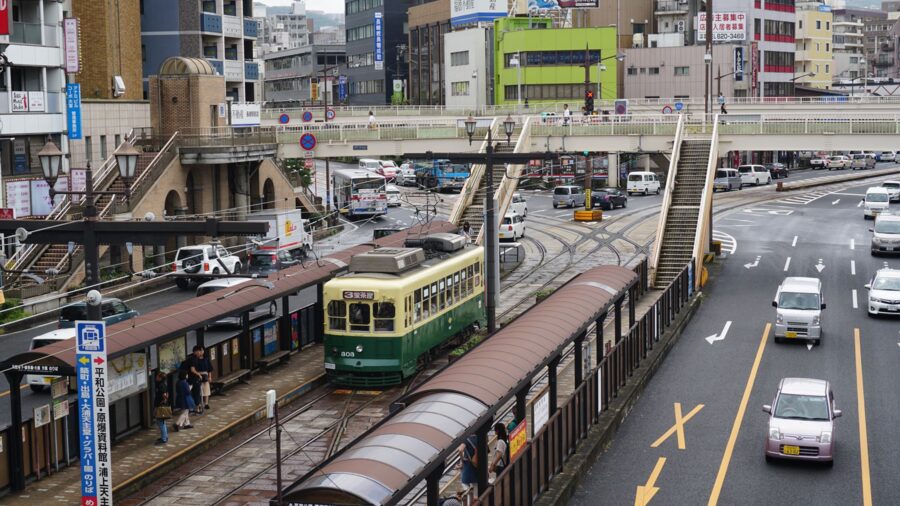
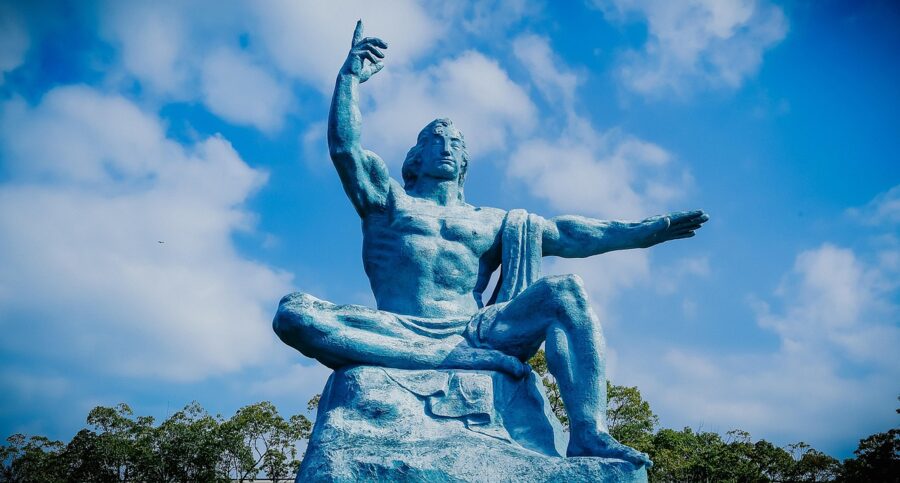
A cheap day built around a morning boat looks like this. Take Gunkanjima Cruise at 09:10 (¥4,250) or Yamasa at 09:00, eat near the harbour, then ride north to the Peace Park stop. Peace Park costs nothing, and the Atomic Bomb Museum’s admission, a short walk south, is ¥200, open from 08:30 to 17:30 for most of the year and to 18:30 from May to August.
Since April 2026 the city has made the museum free for everyone of high school age and under, while keeping the adult price at ¥200. An audio guide in a dozen languages is ¥160 more. It is the best ¥360 in Nagasaki.
Then ride south for the paid sights, and choose rather than collect:
- Glover Garden’s admission is ¥1,300 for adults since a city price change in April 2026. It opens 08:00–18:00 and stays open until 20:00 through November and December, so it fits after a boat day.
- Oura Cathedral’s entry is ¥1,000 for adults, right at the foot of the same slope.
- Dejima’s admission is ¥1,100 for adults, open 08:00–21:00, a short tram hop from Ohato.
Add it up: a Gunkanjima Cruise landing, a day pass, the Atomic Bomb Museum and Glover Garden come to ¥6,350. That is ¥300 less than one weekend Standard ticket with Concierge, and you will have seen a good deal more than the island and one museum.
What a guide and a car cost for a full day
The packaged version is sold on Viator as a Nagasaki full-day tour with licensed guide and vehicle. It is priced in whatever currency you browse in, with no fixed yen figure, so set it against the yen prices below before you pay.
Nagasaki’s own tourism bodies publish what the parts cost, starting with the city tourism association’s list of English guides. None of these includes a Hashima landing: the boat company supplies its own guide on the walkway, and your guide’s fare would be yours to pay.
| Option | Price | Length | Catch |
|---|---|---|---|
| Nagasaki Crew English guide | ¥37,000 per group | Up to 8 hours | Guide only; you pay their fares, admissions and a ¥1,500 lunch allowance |
| Nagasaki Crew, half day | ¥25,000 per group | Up to 4 hours | Book by 17:00 four days ahead |
| Nagasaki Walks guide | ¥4,000 per person | 2 hours | Up to five people; transport and admissions extra |
| Sightseeing taxi from Nagasaki Airport | ¥47,500 for one; ¥18,000 each for three | About 3 hours of sightseeing | Starts or ends at Nagasaki Airport |
The Nagasaki Crew price sheet is set by DMO Nagasaki, the city’s tourism association, which trains and certifies about 40 local English guides. The fee does not change with group size, extra hours are ¥6,000 each, and there is no transport charge if you meet in central Nagasaki. Be clear about the word licensed: the 2026 sheet says Crew guides do not hold the national guide-interpreter licence, and the 2027 sheet says only a few do.
If you want a licensed guide-interpreter, Nagasaki Prefecture’s list of registered interpreter guides has 18 entries you can contact directly, and they quote individually. Nagasaki Walks is the budget end, run by local residents under Keirinkai, the Nagasaki University economics alumni association, payable in cash yen to the guide, with extensions at ¥2,000 an hour.
The simplest priced way to add a vehicle is a Nagasaki Bus Kanko sightseeing taxi plan. Run with Lucky Taxi, it collects you at Nagasaki Airport, stops at Meganebashi, Dutch Slope, Glover Garden, Dejima and Shinchi Chinatown, and drops you at your hotel or the station. The price includes the taxi, the driver’s commentary, tolls, parking and admission to Glover Garden and Dejima: ¥47,500 alone, ¥25,500 each for two, ¥18,000 each for three, and ¥20,000 each for four to nine in a larger taxi.
So when does it pay? For one person, almost never: ¥37,000 for a guide is more than eight Gunkanjima landings, and the city is compact enough that the guide would ride the tram with you anyway. For four people the Crew guide comes to ¥9,250 each for a full day, and the taxi plan to ¥20,000 each. That is worth it if you have one day, little Japanese and a real interest in the bombing or the hidden Christians, and not otherwise.
Out on Hashima, the guide is the boat company’s, whatever you paid, and the wave gauge off Iojima makes the only call that counts. Book the ¥4,250 boat for your first morning, keep a day spare, and spend the difference on a ¥600 tram pass and a ¥200 museum ticket.