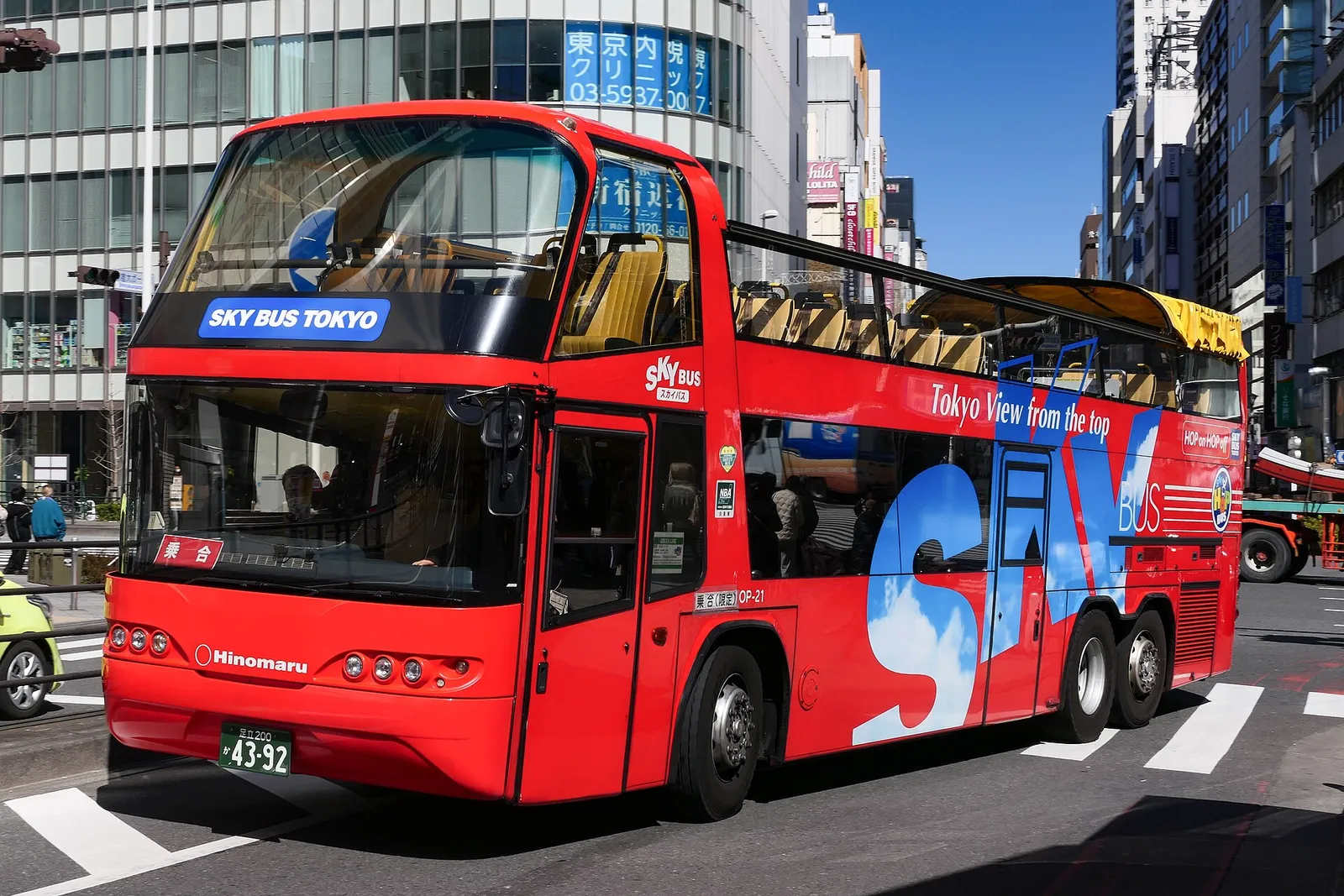
The full-day English bus tour from Tokyo Station costs ¥13,000. It stops at Meiji Jingu, the Imperial Palace Plaza, Asakusa and the Tokyo Skytree. Three of those four charge nothing to walk into, and the fourth costs ¥1,800 if you book it online.
The subway that links them costs ¥700 for a day of Tokyo Metro rides. Add the Skytree ticket and you are at ¥2,500, before lunch, for the same four stops. The other ¥10,500 buys a licensed guide, a coach seat, a buffet and nobody asking you which exit to take.
Sometimes that is worth it. Often it is not. Below are the real bus options in Tokyo, from the ¥2,000 open-top loop to the ¥15,000 day with a bay cruise, priced against doing the same day yourself.
In This Article
- The quick answer, priced
- Hato Bus: the English tours and what each one skips
- TOKYO MORNING and TOKYO AFTERNOON, ¥6,300
- PANORAMIC TOKYO, ¥13,000
- DYNAMIC TOKYO, ¥15,000
- The cheaper Hato day: the Japanese course
- Open-top and hop-on buses: the view, not the stops
- Sky Bus Tokyo, ¥2,000–¥2,400
- Hato Bus open-tops, ¥2,200–¥3,600
- Sky Hop Bus, ¥4,800 for the day
- The same day yourself, on a subway pass
- Which day ticket
- The PANORAMIC TOKYO stops, by subway
- The morning tour, by subway
- When the bus is worth it, and when it is not
- Pay for the bus
- Skip it
The quick answer, priced
Fares and tour prices here are the ones in force in November 2026, adult, tax included. Every bus below leaves from the Marunouchi side of Tokyo Station, within a few minutes’ walk of the Marunouchi South Exit.
| Option | Price | Hours | What is included | Catch |
|---|---|---|---|---|
| Sky Bus T1 (open-top, no stops) | ¥2,000 weekday, ¥2,200 weekend | About 50 min | Recorded English audio | One departure a day in late 2026 |
| Hato Bus TOKYO Panorama Drive (open-top, no stops) | ¥2,200–¥2,400 | 1 hour | GPS audio guide on your phone | Bring your own earphones |
| Hato Bus TOKYO Short Trip (covered double-decker) | ¥3,200 | About 2 hours | Tokyo Tower Main Deck entry | Japanese-language course |
| Sky Hop Bus 1-Day Ticket | ¥4,800 | Same day only | Three routes, recorded audio in 7 languages | No live guide, no toilets, gaps between buses |
| Hato Bus TOKYO MORNING (English) | ¥6,300 | 09:00–13:00 | Licensed English guide, Tokyo Tower Main Deck | No lunch |
| Hato Bus Tokyo Meisho Sanpo (Japanese) | ¥7,980 | 10:20–15:40 | Tempura lunch, Tokyo Tower Main Deck, GPS audio | The live guide speaks Japanese |
| Hato Bus PANORAMIC TOKYO (English) | ¥13,000 | 08:20–18:00 | Licensed English guide, buffet lunch, Skytree Tembo Deck | Lunch is out at Haneda Airport |
| Hato Bus DYNAMIC TOKYO (English) | ¥15,000 | 08:40–17:20 | Guide, matcha session, Odaiba buffet, bay cruise, Tokyo Tower | Mondays, Wednesdays and Fridays only |
| Same day yourself on the subway | ¥700–¥1,000 plus entries | Your hours | Unlimited rides for 24 hours | You do the navigating |
If you only want one line: take the subway for the full day, and spend ¥2,200 on an open-top loop over the Rainbow Bridge if you want the view from a bus. Pay for the ¥6,300 morning tour only if a licensed guide is the point.
Hato Bus: the English tours and what each one skips
Hato Bus is Tokyo’s old sightseeing coach company, the yellow buses that leave from the Marunouchi South Exit of Tokyo Station. It runs four English-guided Tokyo courses, each led by a zenkoku tsuyaku annaishi, a nationally licensed guide interpreter. The prices below are from Hato’s own Japanese course pages, which list the English tours in yen.
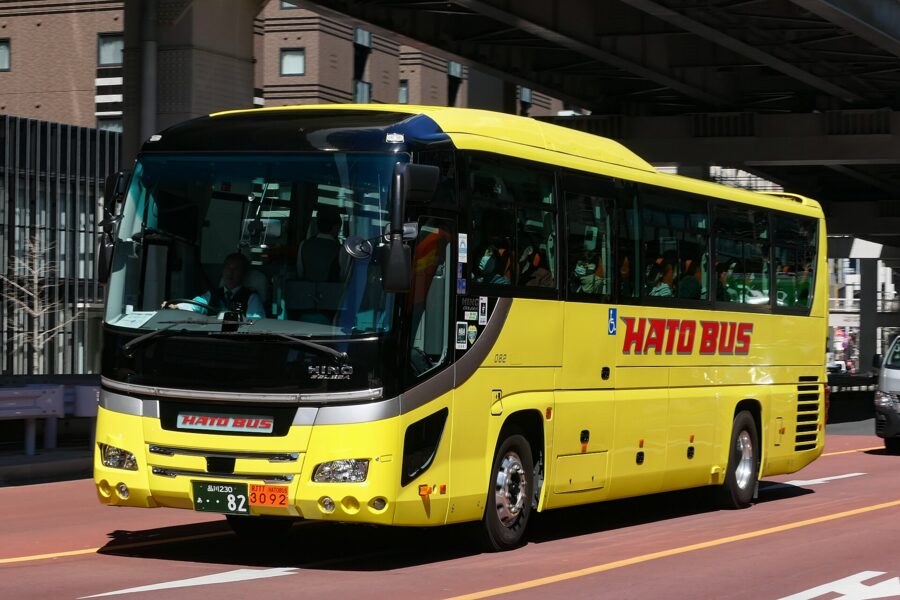
One practical snag first. Hato’s English website is not taking bookings at the moment: its notice of 27 October 2026 sends English-speaking customers to an outside booking site instead, with an email address for questions. The Japanese site still books every course, including the English ones, but the forms are in Japanese.
TOKYO MORNING and TOKYO AFTERNOON, ¥6,300
The TOKYO MORNING course leaves Shinjuku Station East Exit at 08:20 and Tokyo Station at 09:00. You get 40 minutes on the Imperial Palace Plaza, 40 minutes on the Tokyo Tower Main Deck and an hour in Asakusa for Senso-ji and Nakamise, then a drive past Kabukiza and Ginza back to Tokyo Station for about 13:00. There is no meal.
The TOKYO AFTERNOON course is the same three stops in a different order, 14:00 to 18:00 from Tokyo Station, at the same price. Both run daily until 30 December 2026, except Tuesdays and Fridays from 1 to 29 December.
Of the ¥6,300, the Tokyo Tower ticket is worth ¥1,500. The rest pays for four hours of a licensed guide and a seat between stops that are all on the subway map. That is a fair price for a first morning in Tokyo, and the morning tour hands you back the afternoon.
PANORAMIC TOKYO, ¥13,000
This is the full day, and the closest thing to the classic one-day bus tour. The PANORAMIC TOKYO course leaves Tokyo Station at 08:20 and Shinjuku Station East Exit at 08:50. It spends 60 minutes at Meiji Jingu, 40 at the Imperial Palace Plaza, drives past Tokyo Tower and over the Rainbow Bridge, and stops 30 minutes in Odaiba.
Lunch is a buffet at the Villa Fontaine Grand Haneda Airport hotel, which means the coach drives out to the airport and back for it. After that come 50 minutes in Asakusa and an hour on the Skytree Tembo Deck at 350 metres, then Tokyo Station at about 18:00. The Tembo Galleria higher up is not included, and Hato asks you to wear walking shoes.
It runs most days to 28 December 2026, with a 2027 version at the same ¥13,000 from January.
DYNAMIC TOKYO, ¥15,000
The DYNAMIC TOKYO course trades Meiji Jingu and the Skytree for extras: a 60-minute matcha session in Asakusa with stone-mill grinding and a wagashi sweet, a buffet lunch at the Hilton Tokyo Odaiba, a 50-minute Tokyo Bay cruise from 15:00 with coffee or tea, and 45 minutes on the Tokyo Tower Main Deck. It leaves Shinjuku at 08:00 and Tokyo Station at 08:40, and is back at 17:20.
It runs Mondays, Wednesdays and Fridays, excluding public holidays, until 16 December 2026. The 2027 version starts in March, so there is a gap in between.
The cheaper Hato day: the Japanese course
Hato’s Japanese-guided Tokyo Meisho Sanpo course covers the same core stops as the English morning tour and adds lunch, for ¥7,980. It leaves Tokyo Station at 10:20, walks the Imperial Palace Plaza for 40 minutes, sits you down for tempura at Aoi Marushin in Asakusa, gives you 50 minutes at Senso-ji with a box of kaminari okoshi, a puffed-rice sweet, then finishes with 50 minutes on the Tokyo Tower Main Deck. Back at Tokyo Station at about 15:40.
The live guide speaks Japanese. What makes it usable is Hato’s GPS guide service: scan a QR code on board, choose English or one of seven other languages, and recorded commentary plays on your own phone as the bus moves. You need a phone with data in Japan and your own earphones, and Hato is clear that it is not a translation of what the guide is saying.
So the trade is plain. ¥1,680 more than the English morning tour gets you a sit-down tempura lunch, a longer day and a recorded English commentary instead of a live one. If you want to ask questions, take the English tour. If you want to be fed and moved around, this is the better value of the two.
Hato runs a similar Japanese course for people landing at Haneda: course A7625 leaves Haneda Airport Garden at 10:00, includes both Skytree decks and a gyunabe beef hotpot lunch at Yonekyu in Asakusa, and drops you back at Haneda at 17:20 for ¥9,800. If you are going straight into the city instead, the airport bus and train options start far lower.
Open-top and hop-on buses: the view, not the stops
The open-top buses are a different product. They are an hour on the top deck of a double-decker, and most never let you off. Judge them as a view with a commentary, priced like an observation deck.
Sky Bus Tokyo, ¥2,000–¥2,400
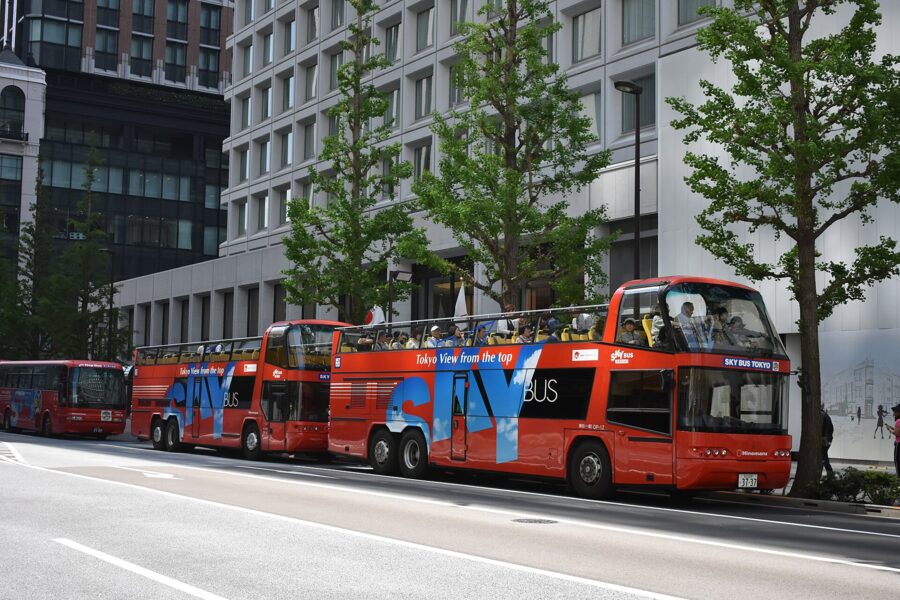
Sky Bus is the red open-top run by Hinomaru Jidosha Kogyo, boarding at stop 1 outside the Mitsubishi Building. Children aged 4 to 12 pay half. There are two daytime loops worth knowing.
The T1 Imperial Palace, Ginza and Marunouchi course is the cheapest of the open-tops at ¥2,000 on weekdays and ¥2,200 at weekends and on holidays, for about 50 minutes. In late November and December 2026 it has one departure a day, 11:30 on weekdays and 11:00 on Saturdays.
The T3 Tokyo Tower and Rainbow Bridge course costs ¥2,200 on weekdays and ¥2,400 at weekends, also about 50 minutes, with departures from 10:30 to 16:30 every day. It loops past Tokyo Tower, crosses the Rainbow Bridge to Odaiba and comes back through Toyosu, Tsukiji and Ginza. Both courses carry recorded audio in English, Chinese and Korean.
Time T3 carefully in winter. Sky Bus notes that the Rainbow Bridge lights come on about 30 minutes after sunset, and sunset in December is 16:28–16:37, so even the 16:30 departure may cross before the lights are on. The separate night course costs ¥2,600 on weekdays and ¥2,800 at weekends from November 2026, and has no audio guide.
Hato Bus open-tops, ¥2,200–¥3,600
Hato’s TOKYO Panorama Drive runs almost the same loop as Sky Bus T3, past the National Diet, Toranomon Hills and Tokyo Tower, over the Rainbow Bridge and back through Ginza. It costs ¥2,200–¥2,400, lasts an hour, leaves Tokyo Station roughly every half hour from 09:30 to 16:00, and nobody gets off. Some weekday departures from January to early March 2027 are cancelled, so check the date.
The better buy is the covered double-decker TOKYO Short Trip, listed on the same Hato Tokyo sightseeing page as the Haneda course, at ¥3,200. It takes about two hours on a similar route and stops at Tokyo Tower with Main Deck entry included, which is ¥1,500 at the window. That leaves ¥1,700 for the bus, with a roof if it rains. Departures are 10:00, 13:00 and 16:00.
For night views, the Tokyo Premium Night Drive leaves at 18:30, includes the Tokyo Tower Main Deck and returns at 20:50 for ¥3,400–¥3,600. Hato warns that the wind on an open deck at night is cold, and the GPS audio guide does not run on the night courses.
Sky Hop Bus, ¥4,800 for the day
The Sky Hop Bus is the hop-on, hop-off version: three routes from the Mitsubishi Building, 19 stops in total, ¥4,800 for a 1-Day Ticket and ¥7,000 for two consecutive days, children half. The red route covers Asakusa, the Skytree and Ueno, the blue route Tokyo Tower, Odaiba and Ginza, and the green route Shinjuku and Shibuya.
Read the small print before paying. The 1-Day Ticket is valid on the day of boarding only, not for 24 hours. There is no live guide, only recorded commentary in seven languages through wired earphones. Its FAQ says there are no toilets on board, staff hand out ponchos when it rains, and a full bus means waiting for the next one.
And the next one can be a while. The green route timetable on the official site shows seven departures from the Mitsubishi Building, the first at 09:15 and the last at 16:45. As transport, ¥4,800 loses to a ¥700 Metro ticket on every count except the view, so treat it as a sightseeing ride and plan on one route, not three.
The same day yourself, on a subway pass
Every stop on the classic bus day sits next to a subway station, and three of them are free. That is the whole case for doing it yourself.
Which day ticket
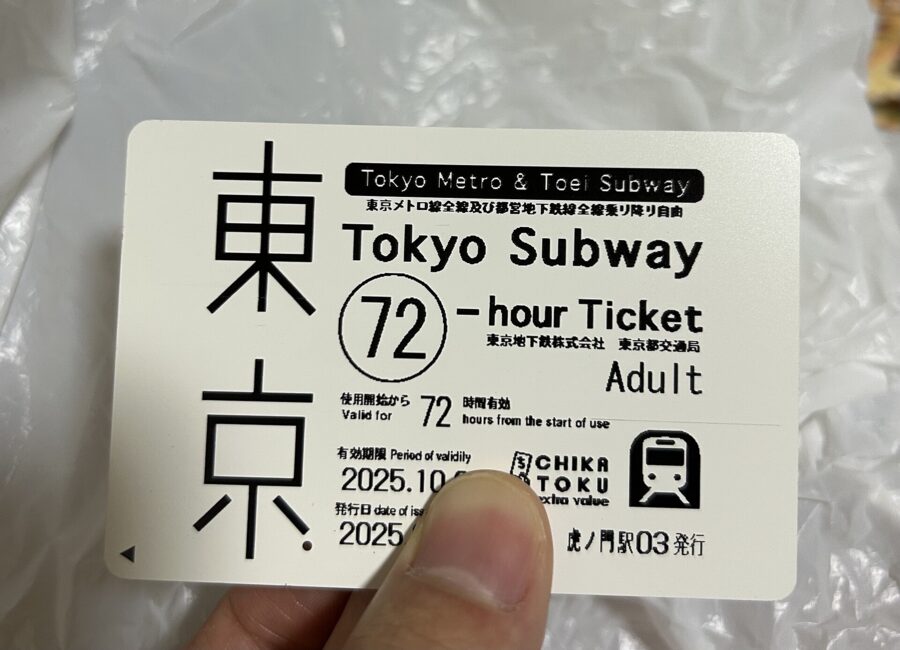
The Tokyo Subway Ticket covers every Tokyo Metro and Toei Subway line: ¥1,000 for 24 hours, ¥1,500 for 48 and ¥2,000 for 72, children half. It is sold to visitors from overseas and to Japanese residents from outside Tokyo and the seven surrounding prefectures, as a paper ticket or a QR code on your phone.
For one day, the cheaper choice is often the Tokyo Metro 24-hour Ticket at ¥700, which covers Metro lines only. The route below stays on Metro, so it is enough. With single Metro tickets at ¥180–¥330 by distance, four rides already cost more than ¥700.
Buy the ¥1,000 Tokyo Subway Ticket instead if you will use a Toei line, such as the Asakusa Line between Oshiage and Asakusa or the Oedo Line to Akabanebashi for Tokyo Tower. If you are staying two or three days, the 72-hour ticket at ¥2,000 is the cheapest per day by a distance.
The PANORAMIC TOKYO stops, by subway
Start at Meiji-jingumae <Harajuku> on the Chiyoda Line. Meiji Jingu charges no entry and opens with the sun: 06:10–16:10 in November and 06:40–16:00 in December. That early gate is the first thing the bus cannot match, because it arrives mid-morning with everyone else.
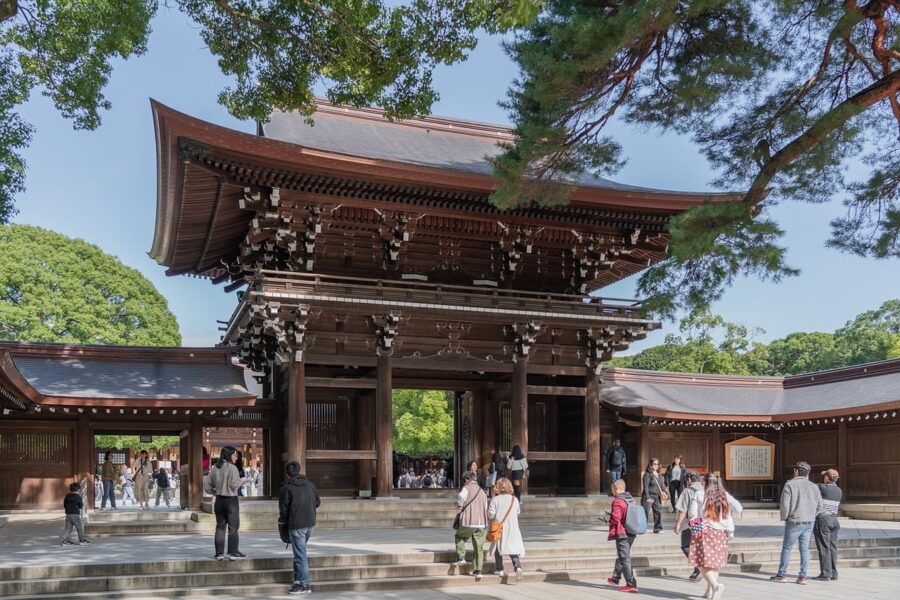
From Meiji-jingumae the Chiyoda Line runs straight to Nijubashimae without a change, and the Imperial Palace Plaza and Nijubashi bridge are a short walk from the exit. Walk on to Otemachi, the next station, and take the Hanzomon Line direct to Oshiage for the Skytree.
The Tembo Deck ticket is from ¥1,800 online for adults, with the price varying by date and a ¥500 surcharge if you buy at the fourth-floor counter or machines. Book online and save the ¥500. From Oshiage, Asakusa is across the Sumida River: walk it, or ride one stop on the Toei Asakusa Line.
Senso-ji charges nothing either. The main hall opens 06:00–17:00, from 06:30 between October and March. Go home from Asakusa on the Ginza Line.
The total: ¥700 for the Metro ticket and ¥1,800 for the Skytree, so ¥2,500, plus whatever lunch you choose in Asakusa. You skip the 30 minutes in Odaiba and the drive to Haneda for the buffet. You keep ¥10,500 and set your own hours.
The morning tour, by subway
The TOKYO MORNING stops cost even less to copy. The Imperial Palace Plaza and Senso-ji are free, and the Tokyo Tower Main Deck is ¥1,500 for adults, 09:00–23:00 with last entry at 22:30. Add a ¥700 Metro ticket and you are at ¥2,200 against the tour’s ¥6,300.
The difference, ¥4,100, is the guide. Four hours with a licensed interpreter who can explain the Imperial Palace, the history of Asakusa and what to eat in it is not a bad use of the money. A coach seat on its own is.
When the bus is worth it, and when it is not
Pay for the bus
- One day, first time, no Japanese. The ¥6,300 morning tour is the cheapest way to have a licensed guide, and you still get the afternoon to yourself.
- A layover through Haneda. Hato’s course from Haneda Airport Garden takes you to Asakusa and the Skytree and puts you back at the airport by 17:20.
- Walking is hard. A coach that parks near each stop saves the long corridors and stairs of Tokyo’s transfer stations. The full-day courses still involve walking, so check the stop times first.
- Heavy rain. A covered coach beats a wet transfer. On the open-tops it is the reverse: Sky Hop hands out ponchos and keeps going.
Skip it
- You are comfortable on a subway. The stops above are a single line or one change apart, and a day ticket covers the lot.
- You want the early hours. Senso-ji and Meiji Jingu open at dawn. The buses arrive with the crowds.
- You want more than an hour anywhere. Every tour stop has a clock on it, including the Skytree hour.
- You only want the view. A ¥2,000–¥2,400 open-top loop gives you the Rainbow Bridge and Tokyo Tower from the top deck without a full-day price.
Bus tours are only one way to see the city with someone else doing the planning. For walking and food tours, see the cheapest tours in Tokyo; for Kamakura, Nikko and Hakone, the cheapest day trips from Tokyo runs the same tour-or-train sums. Hato also runs an English-guided Mt Fuji day for ¥15,000, and the Mt Fuji day tour guide covers the alternatives.
¥13,000 on the coach, or ¥2,500 on the Chiyoda Line with the dawn to yourself at Meiji Jingu. Unless you need the guide, take the subway and let the bus go past.